Flag Memory Match Review: A Globe-Trotting Brain Workout

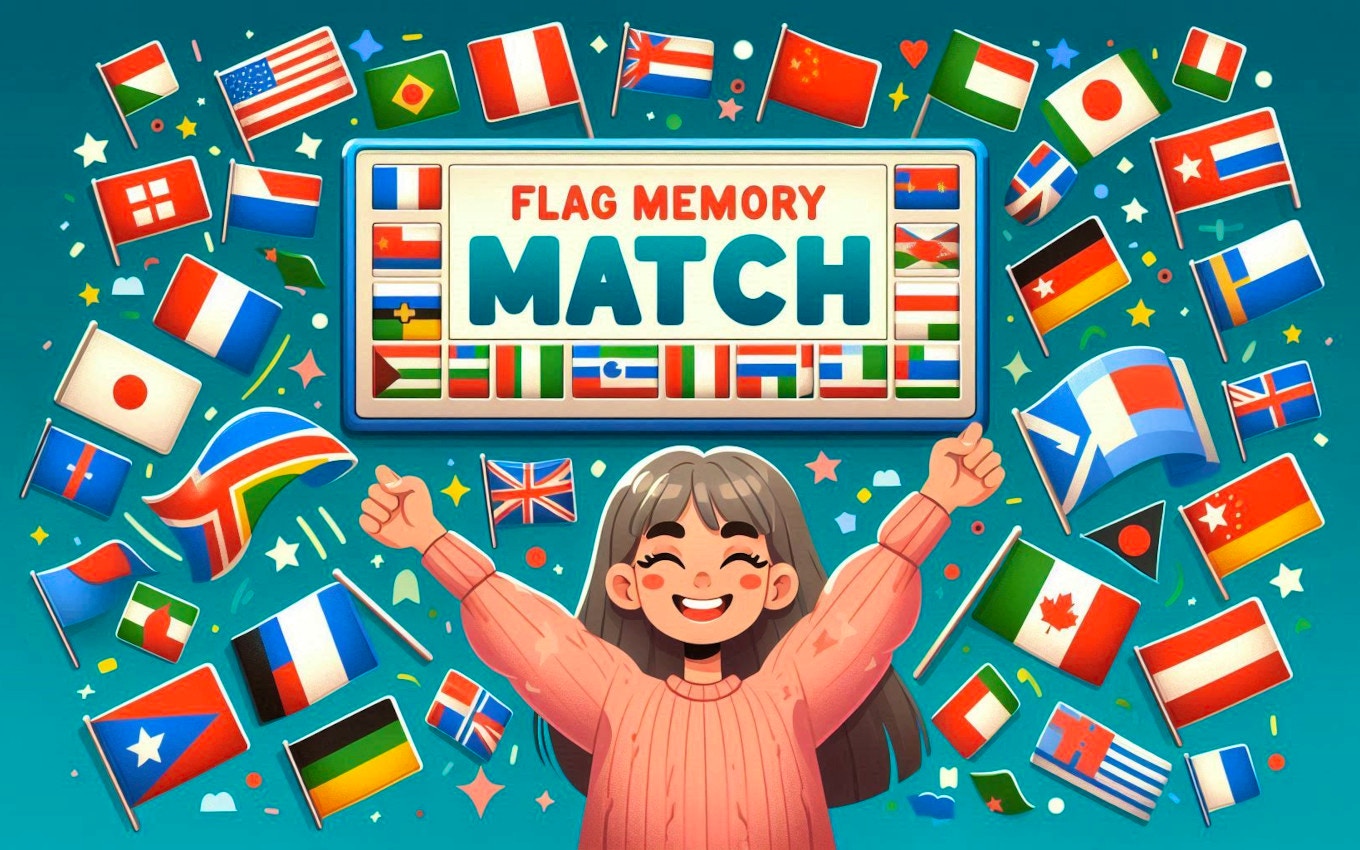
TL;DR: Flag Memory Match turns 98 country flags into a surprisingly addictive memory card game. Six levels ramp up the challenge, testing your recall and speed. It's simple to pick up, educational, and runs smoothly in portrait mode on any browser. A few more visual cues for new players would help, but it's a solid, free brain break.
I'll admit, my geography is rusty. I can spot a Union Jack or the Stars and Stripes, but ask me about Bhutan or Burundi and I'm lost. So when I fired up Flag Memory Match, I expected a gentle stroll. What I got was a proper mental workout disguised as a colorful card game. The game doesn't just test your memory, it quietly teaches you the flags of the world. After a few rounds, I started recognizing patterns I'd never noticed before. That's the sneaky magic here.
What is Flag Memory Match?
Flag Memory Match is a browser-based memory card game that uses the flags of 98 countries as its matching pairs. You flip cards on a grid to reveal flags, then try to find and match identical pairs. Each successful match earns points and clears the cards. The game has six levels of increasing difficulty, adding more cards and complexity as you progress. It's designed for portrait orientation on any device.
Unlike standard memory games with generic fruit or animal icons, this title gives every card real-world meaning. You're not just matching abstract shapes. You're connecting a visual to a country name. It sits in the same family as classic concentration card games but with an educational twist that parents and teachers will appreciate. If you've ever played a memory match game on a restaurant placemat as a kid, you'll know the core loop. This version just swaps cartoon cats for national flags.
How do you play Flag Memory Match?
Tap or click any card to flip it and reveal a flag. Then tap a second card. If the flags match, both cards vanish and you score points. If they don't match, both cards flip back face-down after a brief pause. Your goal is to clear the entire board by finding all matching pairs. You move through six levels, each one adding more cards to the grid. The game tracks your points and pushes you to improve your speed and accuracy.
On my first attempt, I breezed through level one in under a minute. Level two added a few more pairs and I still felt confident. By level four, the grid had grown significantly and my confidence evaporated. I flipped a card showing a tricolor flag with a small emblem, then spent ten seconds hunting for its twin among two dozen face-down cards. The game doesn't hold your hand. You learn to scan for color patterns, stripes, and unique symbols quickly, or you lose precious time. There are no power-ups or hints. It's just you against the grid.
Tips That Actually Work After a Few Rounds
After burning through several attempts, I picked up strategies that made a real difference. First, don't flip randomly. Pick a corner and work methodically across the grid. Random flipping is a fast track to confusion. Second, say the country name out loud when you reveal a flag. The audio reinforcement helps cement the visual in your short-term memory. It sounds silly, but it works.
Third, pay attention to color families. Many flags share red, white, and blue. Grouping them mentally by dominant color narrows your search when you're trying to recall a card's position. Fourth, on later levels with large grids, focus on memorizing two or three card positions at a time rather than trying to hold the whole board in your head. The game rewards precision over panic. Finally, play on a device with a screen large enough to see the flag details clearly. Some flags have subtle differences, and squinting at a tiny phone screen on level five is a genuine disadvantage.
Is Flag Memory Match good for kids and classroom use?
Yes, this game is an excellent fit for kids and educational settings. The flag theme naturally supports geography lessons, and the memory mechanic builds cognitive skills without feeling like a quiz. There are no ads interrupting gameplay during my sessions, which is a huge plus for classroom environments. The difficulty curve is gentle enough that younger players won't hit a wall immediately.
Teachers could easily use it as a five-minute warm-up activity on a projector or let students play individually on tablets. The game doesn't require reading beyond country names, so even early elementary students can participate. Parents looking for screen time that doesn't feel like junk food will find a lot to like here. It's not a full geography curriculum, but as a supplemental tool, it punches above its weight. For more structured learning, pair it with a world map nearby so kids can locate each country after matching its flag.
What the Experience Actually Feels Like
The game loads instantly in a browser, no downloads or sign-ups needed. The portrait orientation feels natural on a phone held in one hand. Cards flip with a smooth, satisfying animation that doesn't lag. The sound design is minimal: a soft click when you flip a card and a pleasant chime for a correct match. There's no music track, which I actually prefer. It keeps the focus on the visual task.
What surprised me was how quickly I got invested. Around level three, I missed a match I was sure I remembered. I actually muttered "no way" at my screen. That tiny emotional spike, frustration mixed with determination, is a sign the core loop works. The game doesn't punish mistakes harshly. You just lose a bit of time and momentum. One honest criticism: the game could use a brief tutorial or at least a visual indicator showing new players that matched cards disappear. My first time through, I wasn't entirely sure the match had registered until I noticed the cards were gone. A small polish point, but worth noting for first-timers.
Why It's Worth Your Time
Flag Memory Match occupies a sweet spot between casual time-killer and genuinely useful brain training. A full run through all six levels takes about ten to fifteen minutes once you know the flags. That makes it perfect for a coffee break, a commute, or winding down before bed. The educational layer means you walk away with something real, even if you only play for five minutes.
This isn't a game for adrenaline junkies or anyone craving deep strategy. The mechanics are deliberately simple and the challenge comes entirely from your own memory limits. If you want explosions, combos, or a narrative, look elsewhere. But if you enjoy the quiet satisfaction of clearing a board through pure recall, you'll find a lot to like. It's the kind of game you keep open in a browser tab and revisit when you need a mental reset. Ready to test your flag knowledge? Give Flag Memory Match a try and see how far you get. You can also explore more memory games or browse our full games library for other free browser titles.
Frequently Asked Questions
Do I need to download anything to play Flag Memory Match?
No downloads are required. The game runs directly in your web browser on mobile or desktop. Just visit the page and start playing immediately.
How many levels does Flag Memory Match have?
The game features six levels that unlock progressively. Each level increases the number of flag pairs on the board, making the memory challenge harder as you advance.
What countries are included in the game?
Flag Memory Match includes flags from 98 countries spanning every continent. You'll encounter major nations alongside smaller states, offering a broad geographic sampling.
Does the game track my high score?
Yes, the game awards points for each successful match and tracks your score during a session. Completing levels faster and with fewer incorrect flips earns higher scores.
Can I play Flag Memory Match on my phone?
Absolutely. The game is designed in portrait orientation at 600x800 resolution, making it a natural fit for smartphone screens. It also works well on tablets and desktop browsers.
Table of Contents
Recent Posts
Retro Speed: A Thrilling Racing Fix for Busy Days
16 hours ago
Arcade Thrills in Pixels: Steve Adventurecraft Review
16 hours ago
PDF to JPG Blurry? How to Convert a PDF Page With Sharp Text
1 day ago
Surviving the Desert: A Fun Idle Adventure
1 day ago
Balloon Smash: Casual Fun with a Thorn Twist
1 day ago
Hidden Object Puzzle Fun with Grimace Shake
2 days ago