Google I/O 2026: Gemini Spark, Search & AI Agents

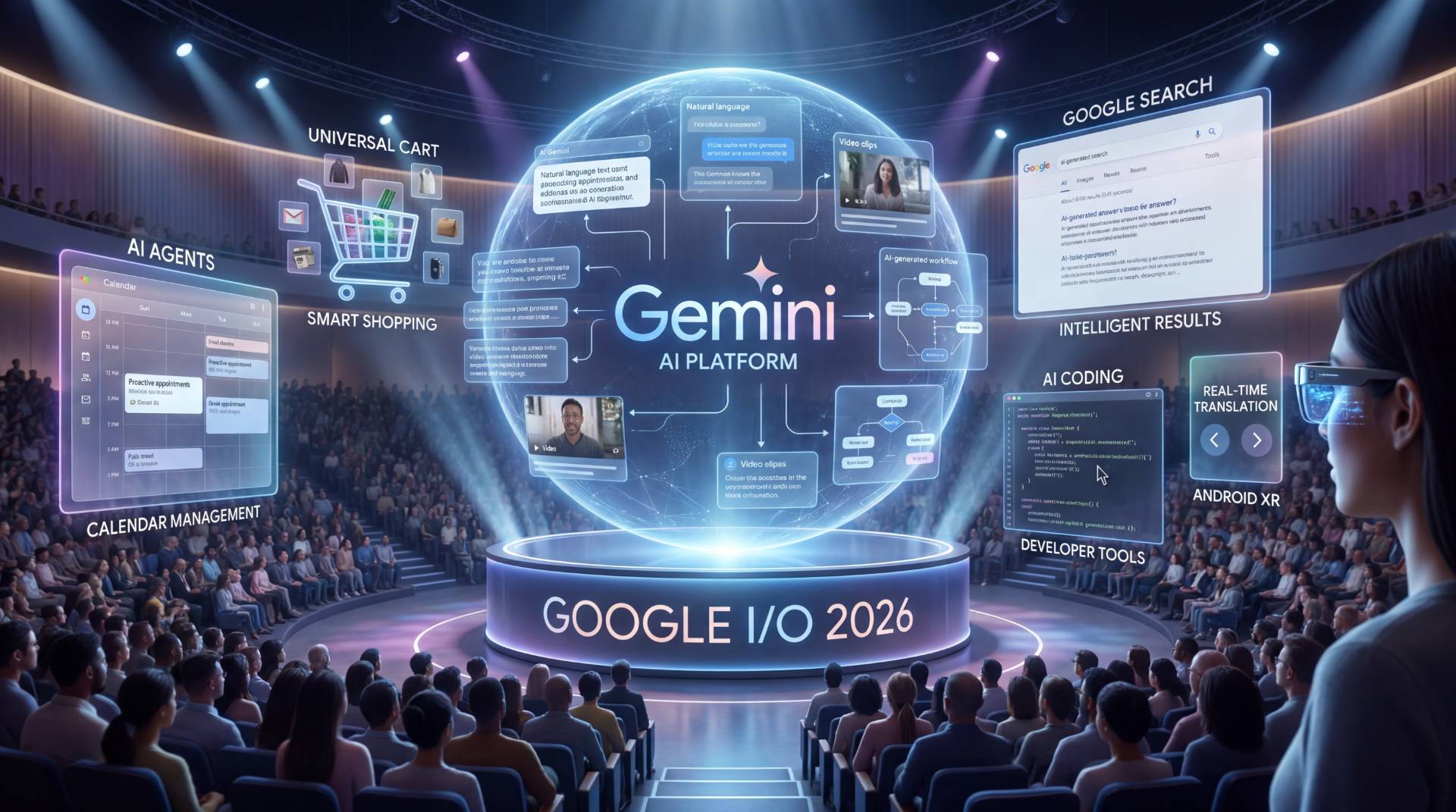
Every year, Google I/O comes with a lot of noise. Big stages, bigger announcements, demos that look impressive and ship six months late. This year felt different. Not louder, different. The May 19–20 event at Shoreline Amphitheatre in Mountain View had a quieter confidence to it, the kind that comes when you're not trying to catch up anymore.
Sundar Pichai opened with a line that set the tone: "We're now in the part of the AI cycle where people want to see the value in the products they use every day." That's a direct acknowledgment that demos don't cut it anymore. People want AI that actually does something useful, reliably, in the apps they already open every morning.
That's exactly what Google I/O 2026 delivered. Here's everything that matters.
Two New Models: Gemini 3.5 Flash and Gemini Omni
The model announcements came first, and they were worth the wait. Google launched Gemini 3.5 Flash, the first model in a new family Google describes as "frontier intelligence with action." It's not just faster, though it is that, running 4x quicker than comparable models on output. The bigger shift is architectural. It was built from the ground up to execute tasks, not just answer questions. Google calls this "agent-first" design, and it shows in the benchmarks: Gemini 3.5 Flash outperforms Gemini 3.1 Pro on coding and agentic tasks, while costing significantly less to run. It's available today in the Gemini app, Google Search, and the Gemini API.
Alongside it came Gemini Omni, a different kind of model entirely. Feed it anything, text, images, audio, video, and it creates video output. Not rough, draft-quality video. Polished, editable, grounded in real-world knowledge and conversational to refine. Gemini Omni is the engine behind Google Flow and Flow Music, both of which are now available as standalone mobile apps. Gemini 3.5 Pro, the more powerful reasoning model, is in testing and coming next month.
Gemini Spark: AI That Works While You Sleep
Of everything announced, Gemini Spark is the one that will change how ordinary people think about AI on a daily basis. Google describes it as a 24/7 personal AI agent. Not a chatbot you open when you have a question, but something that runs in the background, learns your patterns, and surfaces information you need before you've even thought to ask for it.
The Daily Brief is part of this. Every morning, Spark assembles a personalized rundown from your calendar, your email, your interests, and the news. The agent doesn't wait for instructions. It knows your routine and works around it. That's a meaningful shift from what AI assistants have been so far, reactive tools that answer when called, toward something that actually behaves like a personal assistant.
Gemini Spark is rolling out to Google's AI Plus, Pro, and Ultra subscribers. Google also introduced a new $100/month AI Ultra plan at I/O, giving subscribers priority access to the most capable Gemini models and the most advanced agentic features.
Google Search Gets Its Biggest Rethink in Decades
The Search announcement was the most structurally important thing that came out of I/O 2026, even if it wasn't the flashiest. Google introduced Information Agents in Search, AI agents that don't retrieve links so much as they actively research, reason, and respond to complex queries on your behalf.
Ask it to plan a trip, compare products across multiple stores, or walk through a multi-step research task, and you get a structured, useful answer rather than ten links to click through.
Google also noted a telling milestone: one year after AI Mode launched in the US, users are shifting from short keyword queries to full natural language questions. People are starting to treat Search less like a search engine and more like a knowledgeable colleague.
For website owners, this creates a real urgency around how your content is structured. AI agents are reading your pages differently than humans do. Your meta titles, descriptions, and site structure are the signals they rely on to decide whether to surface your content. If you haven't checked your site's metadata quality recently, FileReadyNow's Metadata Checker and Sitemap Checker are practical places to start.
Universal Cart and the Agentic Shopping Era
Google launched Universal Cart, an AI-powered shopping experience that lets you browse products from different merchants and add them to a single, unified cart, all through Gemini, without bouncing between tabs or managing five separate checkouts. Google is calling this the foundation of "agentic commerce."
The implications for e-commerce are significant. If Gemini is increasingly where shopping decisions start, how your products are described, priced, and indexed through Google becomes more important than ever. This is AI going transactional, and it's going to reshape what "good SEO" looks like for online stores.
Intelligent Eyewear: Google's Hardware Bet for Fall 2026
The most visual moment of the keynote came near the end. Under the Android XR platform, Google unveiled Intelligent Eyewear, smart glasses with Gemini built in.
Get real-time directions overlaid on what you're looking at. Translate a sign without pulling out your phone. Snap photos, send texts, ask questions about whatever is in front of you. They're launching this fall.
This is the most credible version of the smart glasses vision Google has ever shown. The hardware has always been theoretically interesting. What was missing was software ready enough to make it genuinely useful. With Gemini now mature enough to handle real-world context quickly, that gap has closed considerably.
Android Halo, Workspace Voice, and the Quiet Upgrades That Add Up
Beyond the headline items, I/O 2026 was filled with product updates that quietly reshape how you work every day. Android Halo brings your AI agent's status directly into the Android status bar, so you can see what your agent is doing in the background without opening any app.
Google Workspace got voice input across Gmail, Docs, and Keep, not just basic dictation, but contextual voice commands that understand intent. Google Pics is a new design tool for creating visual assets inside Google's ecosystem. Google Stitch lets you design layouts in real time, guiding and reflowing as it builds. Pomelli, from Google Labs, can build your entire brand book and launch a website with AI agents doing most of the heavy lifting.
YouTube got its own set of updates tool, new search tools and Ask YouTube, which lets you ask questions about video content without having to sit through the whole thing first. And SynthID watermarking is now expanding beyond the Gemini app into Search and Chrome, making AI-generated content identifiable across the web.
For Developers: Google Antigravity and Co-Scientist
On the developer side, Google pushed hard on Google Antigravity, its agent-first development platform. Instead of writing complex orchestration code for AI agents, developers can now define everything in markdown files and register them as named agents.
Native Android vibe coding support, an AI Studio mobile app, and Google Workspace integrations were all part of the package.
Google DeepMind also announced Co-Scientist, a multi-agent AI system built to accelerate scientific research. It's a collaborative AI partner that helps researchers design experiments, analyze data, and push toward breakthroughs faster.
On the same front, Gemini for Science launched as a dedicated toolkit for scientific exploration.
The Bigger Picture
There's a pattern running through everything at I/O 2026, and it's worth naming directly. Google is no longer building AI tools that wait for you to use them. Gemini Spark works while you sleep. Android Halo shows you what your agent is doing in the background. Information Agents in Search don't wait for a query, they reason. Universal Cart doesn't wait for you to browse it shops.
The shift is from AI that responds to AI that acts. And with Google's distribution advantage across Search, Gmail, Android, YouTube, Maps, and now eyewear, the scale at which this plays out is hard to overstate. I/O 2026 wasn't a product roadmap. It was Google drawing a clear line between the AI era that just ended and the one that's starting now.
Frequently Asked Questions
Gemini Spark is Google's new 24/7 personal AI agent, announced at Google I/O 2026. Unlike a regular chatbot, it works proactively in the background — learning your patterns, preparing a personalized Daily Brief each morning from your calendar, email, and the news, and surfacing information before you ask. It is rolling out to Google AI Plus, Pro, and Ultra subscribers.
.Gemini 3.5 Flash is built for speed and agentic tasks — it is Google's fastest frontier model and is designed to execute complex workflows. Gemini Omni is built for multimodal creation: it accepts text, images, audio, and video as input and outputs editable video grounded in real-world knowledge. They are both part of the broader Gemini 3.5 family but serve different purposes.
Significantly. With AI Information Agents now handling complex queries directly in Search, your content structure becomes more critical than before. AI agents rely on metadata, page titles, descriptions, and clean site architecture to decide what to surface. If those elements are incomplete or poorly written, your pages are more likely to be skipped over in favor of better-optimized sites.
Table of Contents
Recent News

GPT-6 Sol Explained: Pricing, 1M Context Window, Limits, and Who Should Use It
2 weeks ago
Title: Microsoft 365 Copilot Gets a New Prompt Button Inside Word, Excel, and PowerPoint
2 weeks ago
Gemini 3.8 Flash Is Here: Same Price, Stronger Reasoning, and Better PDF Handling
1 month ago
Apple OpenAI Lawsuit Escalates as Both Sides Clash Over Confidential Data
1 month ago
ChatGPT Gets Major File Updates: Voice Uploads, Google Drive Sync, and Better
1 month ago
Adobe Acrobat Now Works Inside WhatsApp and ChatGPT, Bringing PDFs Straight Into Chat
1 month ago